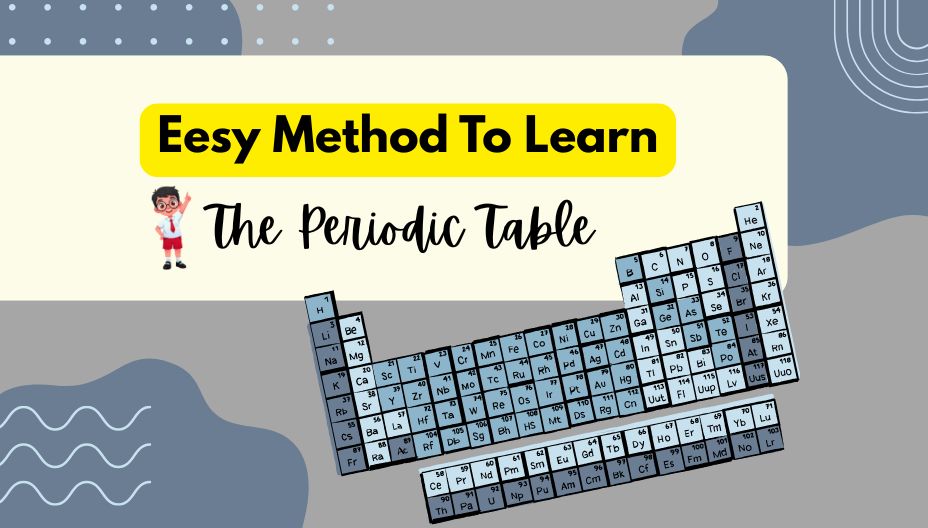
Easy Method to Learn Periodic Table: For beginner to Advanced
Introduction
The periodic table is one of the most important tools in chemistry. It organizes all known chemical elements in a structured way so that scientists and students can easily understand their properties and relationships. However, many students find it difficult to memorize or understand the periodic table at first.
The good news is that learning the periodic table does not have to be hard. With the easy method to learn the periodic table, anyone can understand it in a simple and practical way. This guide explains the periodic table in a human-friendly approach, so students, beginners, and even curious learners can benefit from it.
The official authority that maintains global chemical element standards is the International Union of Pure and Applied Chemistry (IUPAC).
Explore the Official IUPAC Periodic TableWhat is the periodic table?
The Periodic Table of Elements is a chart that arranges all chemical elements according to their atomic number, electron configuration, and chemical properties.
It was first created by Dmitri Mendeleev, a Russian chemist, in 1869. Today, the modern periodic table contains 118 elements.
The table is divided into the following:
- Periods – horizontal rows
- Groups – vertical columns
- Blocks – s, p, d, and f blocks
Each element in the periodic table has unique properties, but elements in the same group often behave similarly.
Why Students Find the Periodic Table Difficult
Many learners struggle with the periodic table because they try to memorize everything at once. The periodic table contains many elements, symbols, and numbers, which can feel overwhelming.
Common problems students face include:
- Difficulty remembering element symbols
- Confusion between groups and periods
- Trying to memorize instead of understanding patterns
The solution is to use smart learning techniques rather than rote memorization.
Easy Method to Learn Periodic Table
If you want an easy method to learn the periodic table, follow these practical steps:
1. Understand the Structure First
Instead of memorizing elements randomly, start by understanding how the table is arranged.
- Periods represent increasing atomic numbers.
- Groups contain elements with similar chemical properties.
- Elements on the left are mostly metals.
- Elements on the right are mostly non-metals.
When you understand this structure, learning becomes much easier.
2. Learn by Groups Instead of the Whole Table
A very effective method is to learn elements group by group.
For example:
Group 1 – Alkali Metals
- Hydrogen (H)
- Lithium (Li)
- Sodium (Na)
- Potassium (K)
Group 17 – Halogens
- Fluorine (F)
- Chlorine (Cl)
- Bromine (Br)
- Iodine (I)
By focusing on groups, you remember patterns more easily.
3. Use mnemonics and memory tricks.
Mnemonics are powerful tools for remembering sequences.
Example for the first elements:
H He Li Be B C N O F Ne
Mnemonic example:
Happy He Likes Being Cool Near Old Friendly Neighbors
Students can create their own funny or meaningful sentences to remember element sequences.
4. Visual Learning Works Better
Humans learn faster with visual memory.
Try these techniques:
- Use a color-coded periodic table
- Print and place it on your study wall
- Use flashcards
- Study charts regularly
Seeing the periodic table daily helps your brain remember it naturally.
5. Practice with Quizzes and Games
Interactive learning improves memory retention.
Try:
- Online periodic table quizzes
- Educational apps
- Matching games
- Timed challenges
Gamifying learning makes chemistry more interesting and less stressful.
6. Learn Element Stories and Uses
Understanding how elements are used in real life makes them easier to remember.
Examples:
- Oxygen (O) – essential for breathing
- Iron (Fe) – used in construction and tools
- Gold (Au) – used in jewelry and electronics
When you connect elements with real-world uses, they become meaningful rather than abstract.
7. Study in Small Sections
Instead of trying to learn all 118 elements at once, divide them into smaller sections.
For example:
- Learn 10 elements per day
- Review the previous day’s elements
- Test yourself weekly
Within two weeks, you can become comfortable with the entire periodic table.
Benefits of Learning the Periodic Table Easily
Using the easy method to learn the periodic table offers many benefits:
- Better understanding of chemistry concepts
- Improved exam performance
- Strong scientific foundation
- Faster recall during tests
- Greater confidence in science subjects
Once students understand the periodic table, many chemistry topics become easier.
Looking for more study resources and learning guides? Explore our complete collection of education articles designed to help students learn faster and smarter.
Browse More Education ArticlesTips for Long-Term Memory
To remember the periodic table for a long time:
- Revise regularly
- Teach others what you learned
- Use diagrams and charts
- Practice writing the table from memory
The more you interact with the periodic table, the stronger your memory becomes.
Conclusion
Learning chemistry does not have to be complicated. With the easy method to learn the periodic table, students can understand the structure, patterns, and elements without stress.
By focusing on groups, mnemonics, visual tools, and real-life connections, anyone can master the periodic table in a simple and human-friendly way.
Start with small steps, practice regularly, and soon the periodic table will feel like a natural part of your knowledge.
Remember: Chemistry becomes easier when the periodic table becomes your friend.